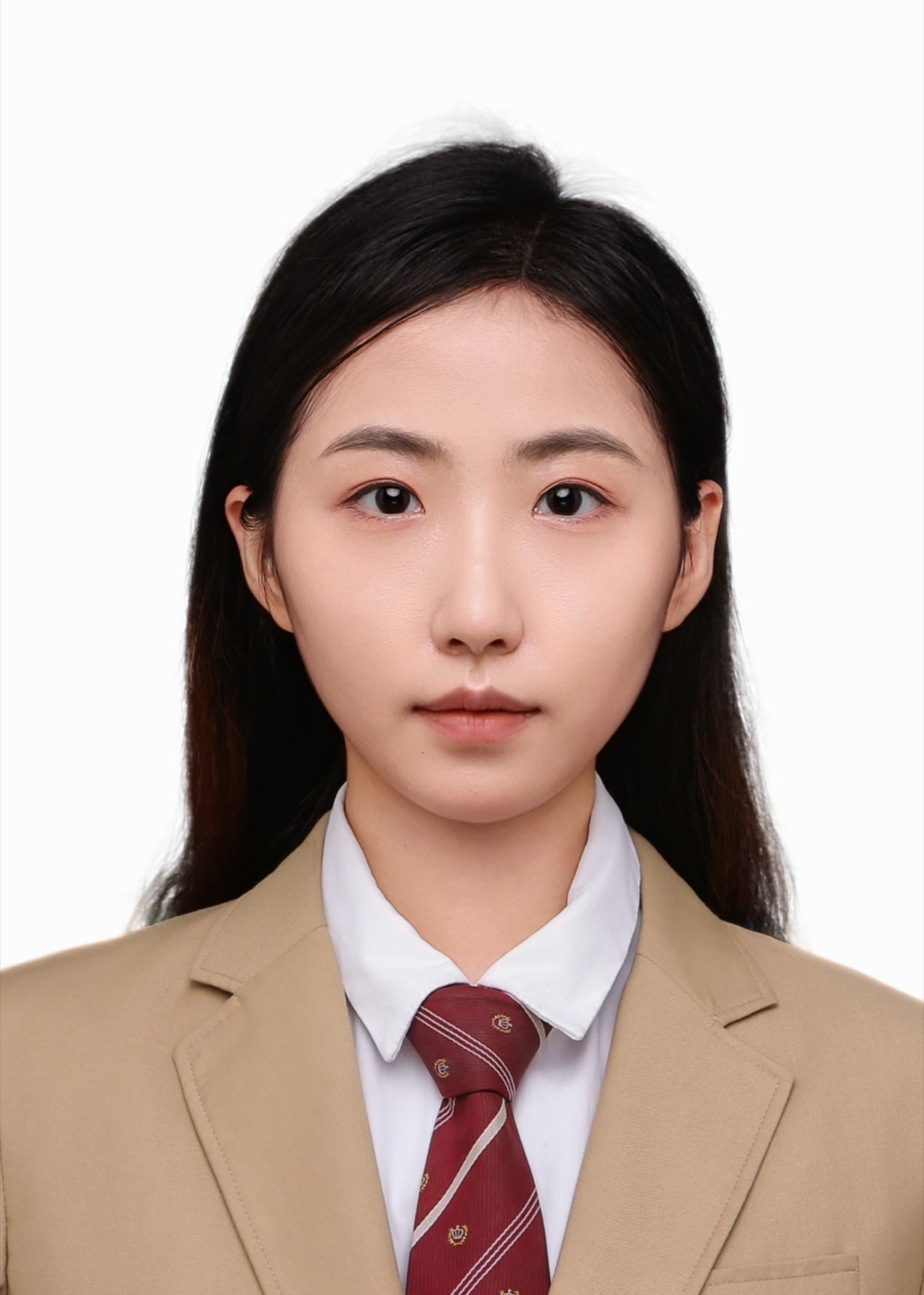
Chenyu Wang

Chenyu Wang (王晨瑜)

Multimodal Agent Research Intern · Shanghai AI Laboratory

M.S. candidate · SIMIT, UCAS · Expected graduation: June 2027

Research Interests: Large Language Models and AI Agents for Healthcare

Additional Research: Transfer Learning and Unsupervised Domain Adaptation

About Me

I am an M.S. candidate in Electronic Information at the University of Chinese Academy of Sciences (UCAS), based at the Shanghai Institute of Microsystem and Information Technology (SIMIT) under Baoqing Li and Min Tu. I expect to graduate in June 2027 and am currently a Multimodal Agent Research Intern at Shanghai AI Laboratory.

My research focuses on large language models and AI agents for healthcare. I am the first author of two manuscripts on guideline-supervised ophthalmic triage and sensor-domain adaptation, currently under review at AAAI and IEEE Sensors Journal, respectively. My ongoing work covers retrieval-augmented oncology decision support and agent-tool risk attribution.

As the sole participant and project lead of ucas_xlab at the ECCV 2026 SLoMO Workshop competition, I placed 2nd in AD Special and 3rd in AD Main, independently developing systems for audio description and movie question answering.

Research & Internship Experience

Shanghai AI Laboratory

2026.03 — Present

Multimodal Agent Research Intern · Frontier Multimodal Research

Research Highlight 1: Guideline-Supervised Clinical Agents

2026.03 — 2026.08

Guideline-as-Oracle: Ophthalmic Telephone Triage · First-author manuscript under review at AAAI

  • Data & training: Developed a guideline-to-dialogue pipeline to address the cost of annotating multi-turn clinical conversations, converting a 70-row ophthalmic rule table into 3,000 training dialogues with rule-derived urgency labels. Performed full-parameter SFT of a 9B model using class resampling and nurse-role token supervision, and investigated Outcome GRPO as an exploratory post-training approach.
  • Evaluation: Relative to the base 9B model, improved agreement from 61.7% to 74.1% and emergency recall from 9.5% to 69.0% on 201 internal rule-reference cases; checked robustness with a second training seed and patient simulator.

This reference also informed development and model selection, so these results measure internal policy conformance rather than held-out clinical generalization.

Research Highlight 2: Evidence-Grounded Clinical Decision Support

2026.08 — Present

Retrieval-Augmented mCRC MDT Decision Agent · Ongoing

  • Data: Investigating how longitudinal records and retrieved cases support prediction of five recorded MDT management actions for metastatic colorectal cancer. Built a single-center data pipeline from 9,779 encounters / 4,983 patient records spanning 2013–2025; integrity screening retained 8,274 encounters / 4,077 patients. Restricted inputs to information available before each target meeting.
  • Evaluation design: Froze a test set of 1,247 encounters from 610 patients, with no patient overlap across splits. Compared classical machine learning, retrieval, and language-model approaches using a common evaluation protocol.
  • Method & results: Combined longitudinal history, similar-case retrieval, and XGBoost probability priors in a patient-time-aligned language-model prompt. Achieved 64.1% accuracy and 0.527 macro-F1, compared with 57.3% and 0.453 for the strongest classical baseline: gains of 6.8 percentage points in accuracy and 0.074 in macro-F1.
  • Longitudinal information: For encounters with prior patient history, accuracy increased from 55.4% to 66.1% relative to the classical model.

Current results measure retrospective agreement with recorded MDT actions; prospective clinical benefit remains untested.

DSH: Component-Level Static Auditing and Risk Attribution

2026.08 — Present

Ongoing

  • Audit framework: Developing dependency-closure attribution and four-level evidence scoring across 12 security domains for agent software components. Coverage includes 207 repositories, 12,830 components, and 11,124 entry points. The method distinguishes shared-dependency findings from risks specific to individual components.
  • Validation & reproducibility: Combined AST parsing with intra-procedural taint analysis to reduce items requiring manual review from 4,794 to 153; the remaining 153 represent 1.4% of all 11,124 entry points. Consolidated findings into 24 code defects. Two clean-environment reruns produced byte-identical results with fixed source and parser versions.

UnifiedGas: Domain Adaptation for Sensor Drift

2025.07 — 2026.03

Graduate researcher · SIMIT, UCAS · First-author manuscript under review at IEEE Sensors Journal

  • Method: Developed a single-stage unsupervised adaptation framework for temporal drift and cross-device distribution shift, combining hierarchical MK-MMD, CORAL, dual-level center regularization, and multi-head classification; also studied a relative-response front end and the conditional adversarial variant UnifiedGas-C.
  • Results: On UCI Drift, obtained 81.10% / 84.36% mean accuracy for fixed-source / sequential transfer using retrospective target-label-based best-epoch selection. On the full-cycle Twin Arrays track, fixed-source / adjacent-board accuracy was 100.00% / 100.00% for UnifiedGas-C and 100.00% / 99.94% for CDAN under the same frontend-matched protocol.

Multimodal Competitions

ECCV 2026 SLoMO Workshop · Long-video Understanding & Description Generation

Sole participant and project lead (registered as ucas_xlab). Independently developed systems for audio description (AD) and movie question answering (MovieQA), covering temporal context, visual evidence, and candidate selection.

2nd in AD Special and 3rd in AD Main, according to the official final rankings.

Official final results on the private test sets
TrackFinal rankMetricMethod
AD Special ↗#2AD Score 49.80Developed a zero-shot Qwen3.5-35B-A3B pipeline combining dense frame sampling, temporal context, and time-budget-aware descriptions.
AD Main ↗#3AD Score 53.47Designed a description-refinement pipeline using baseline anchors, visual-evidence checks, and blind dual-judge selection.
MovieQA Main ↗#4Accuracy 64.40%Built a movie question-answering pipeline combining multi-scale temporal sampling, subtitle/ASR alignment, cross-clip evidence retrieval, and model consensus.
MovieQA Special ↗#5Accuracy 51.02%Combined 8/64/128-frame views from a frozen Qwen3-VL-8B model with weighted Jaccard consensus.

Manuscripts & Preprints

[1]
[2]
UnifiedGas: End-to-End Unsupervised Domain Adaptation for Drift-Robust Gas Classification, IEEE Sensors Journal, under review (First author)

Future Research Interests

I am interested in applying large language models and AI agents to medicine and exploring how they can reshape the way AI is used in healthcare. Building on my experience in medical dialogue modeling and clinical decision support, I hope to develop intelligent systems that support more interactive, adaptive, and reliable clinical workflows.

Education

University of Chinese Academy of Sciences (UCAS)

M.S. in Electronic Information

Shanghai Institute of Microsystem and Information Technology (SIMIT)

Advisors: Baoqing Li and Min Tu

2024.09 — 2027.06 (expected)

Xi'an University of Technology

B.Eng. in Electrical Engineering and Automation

School of Electrical Engineering · Advisor: Kaiyan Wang

2019.09 — 2023.07

Skills & Honors

Technical Skills

  • Programming & modeling: Python, PyTorch, scikit-learn, XGBoost; full-parameter SFT, GRPO exploration, retrieval-augmented generation, multimodal reasoning, and unsupervised domain adaptation.
  • Research engineering: Clinical data curation, patient/time-aware evaluation, source ablations, reproducible pipelines, model calibration, AST parsing, and static taint analysis.

Selected Honors

  • Merit Student, University of Chinese Academy of Sciences, 2026
  • First-class Scholarship, Xi'an University of Technology, 2020 / 2021 / 2022
  • Third Prize for Innovation Achievement, Xi'an University of Technology, 2022
  • Outstanding Student Cadre, Xi'an University of Technology, 2020 / 2021 / 2022